Container ship
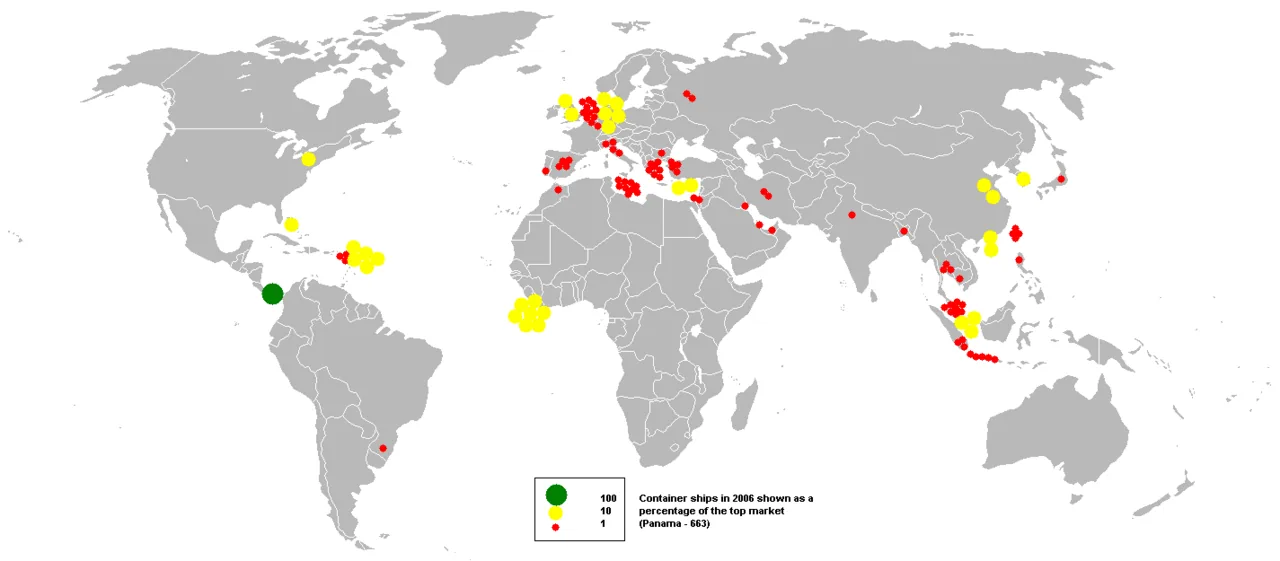
A container ship — also called a boxship or containership — is a cargo vessel that carries its entire load in truck-sized intermodal containers, a practice known as containerization. Container ships are the dominant mode of commercial intermodal sea freight and now move the great majority of non-bulk goods traded internationally.
As of 2023, the largest container ships in service can carry more than 24,000 twenty-foot equivalent units (TEU), and the global fleet numbers roughly 50,000 vessels. Approximately 90% of all non-bulk cargo worldwide moves by container ship.
| Common alternative names | Boxship, containership |
| Cargo unit | Twenty-foot equivalent unit (TEU) |
| Standard container lengths | 20 ft (1 TEU) and 40 ft (2 TEU); 40-ft predominant |
| Share of non-bulk seaborne cargo carried | ~90% |
| Maximum capacity (from 2023) | Over 24,000 TEU |
| Maximum length (largest ships) | ~400 m (1,300 ft) |
| First purpose-built cellular container ship | MV Kooringa, commissioned May 1964 |
| First commercially successful container voyage | Ideal X, Newark to Houston, 26 April 1956 |
| Estimated cargo shipped by container (2009) | ~125 million TEU / 1.19 billion tonnes |
| Cargo-equivalent (largest modern ship vs. pre-WWII freighter) | Equal to 16–17 pre-war freighters |
What is a container ship?
A container ship is a cargo vessel built specifically to transport intermodal freight containers — standardized steel boxes that can be transferred directly between ship, rail and road without unpacking the goods inside. Capacity is expressed in twenty-foot equivalent units (TEU), reflecting the dimensions of the basic 20-foot ISO container. In practice, most shipments travel in 40-foot containers, each counted as 2 TEU.
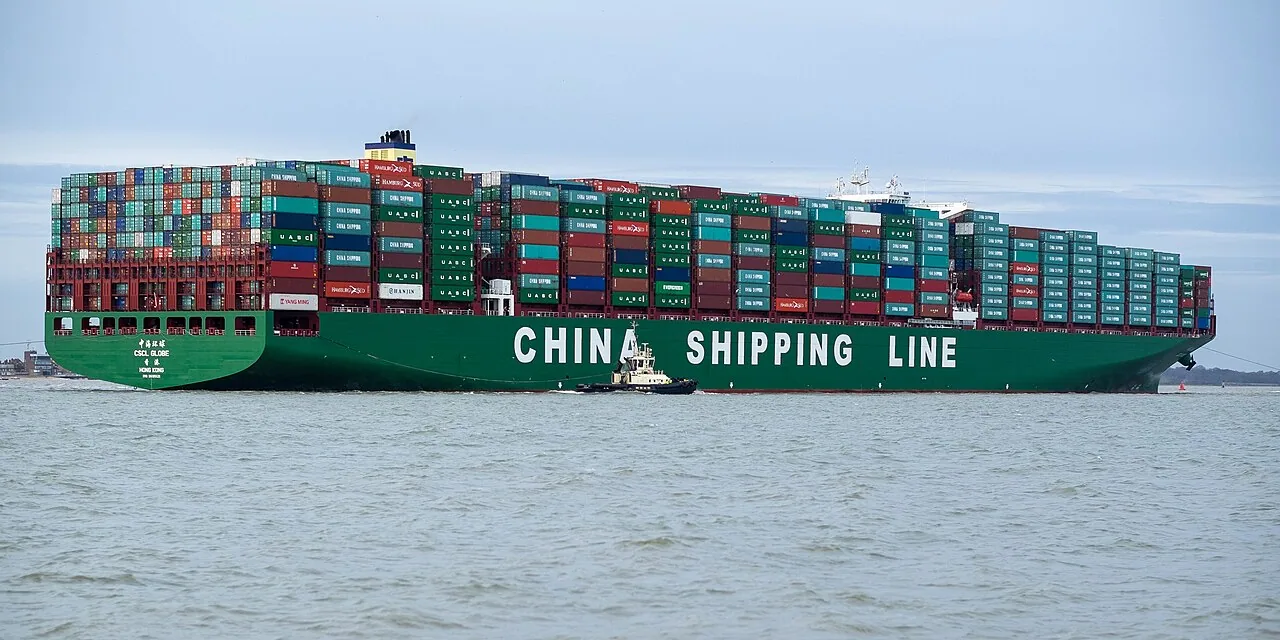
The technique of moving goods this way is called containerization. By grouping between 1,000 and 3,000 cubic feet (28–85 m³) of cargo, or up to roughly 64,000 lb (29,000 kg), into a single sealed unit that is secured to the ship in one standardized operation, containerization has cut shipping time by 84% and costs by 35% compared with the earlier practice of handling goods piece by piece.
How did break-bulk cargo shape the need for containers?
Dry cargo divides into two broad categories: bulk cargo, such as grain or coal, which is carried loose in a ship's hold, and break-bulk cargo, which consists of packaged manufactured goods. Before containerization took hold in the 1950s, break-bulk items had to be manually loaded, lashed, unlashed and unloaded one piece at a time by stevedores — a slow and expensive process.
The transition to containers eliminated nearly all of that individual handling. By 2001, more than 90% of world trade in non-bulk goods was moving in ISO containers, and by 2009 almost one quarter of all dry cargo worldwide — an estimated 125 million TEU or 1.19 billion tonnes — was shipped by container.
When were the first container ships used?
The concept of carrying goods in discrete, transferable boxes is older than is often assumed. In 1766, the engineer James Brindley designed a boat named Starvationer fitted with ten wooden containers to move coal from Worsley Delph to Manchester along the Bridgewater Canal — an early example of purpose-built containerized transport.
In the period before the Second World War, the Southern Railway in Britain used containers to carry luggage for the Golden Arrow / La Flèche d'Or luxury passenger train service between London and Paris. Those containers were loaded at either end of the route and transported to the ports of Dover or Calais on flat cars. In February 1931, the Southern Railway launched what is recorded as the world's first container ship, the SS Autocarrier, which had 21 slots for the railway's own containers.
After the Second World War, the earliest container operations were run with converted surplus T2 oil tankers. By 1951, purpose-built container vessels had begun operating in Denmark and on the route between Seattle and Alaska, marking a step toward vessels designed from the outset for box cargo.
Who made container shipping commercially successful?
The figure most associated with the commercial breakthrough is Malcom McLean. By 1955 he had grown McLean Trucking into one of the largest freight fleets in the United States. That same year he purchased the small Pan Atlantic Steamship Company from Waterman Steamship and set about adapting its vessels to carry cargo in large, uniform metal containers.
On 26 April 1956, the rebuilt tanker Ideal X departed Port Newark, New Jersey, carrying 58 metal containers bound for Houston, Texas. That voyage is widely regarded as the moment modern container shipping began. The first commercially successful container ship therefore was Ideal X — a converted T2 tanker — rather than a purpose-built vessel.
A parallel development occurred in Canada: the White Pass and Yukon Route railway acquired the Clifford J. Rogers, built in 1955 and recognized as the world's first purpose-built container ship, introducing containers to its railway operations in 1956. Meanwhile, standardized steel intermodal containers based on specifications from the United States Department of Defense were beginning to reshape freight transport more broadly during the 1950s, with operators such as Seatrain Lines among the early adopters.
What was the first fully cellular container ship?
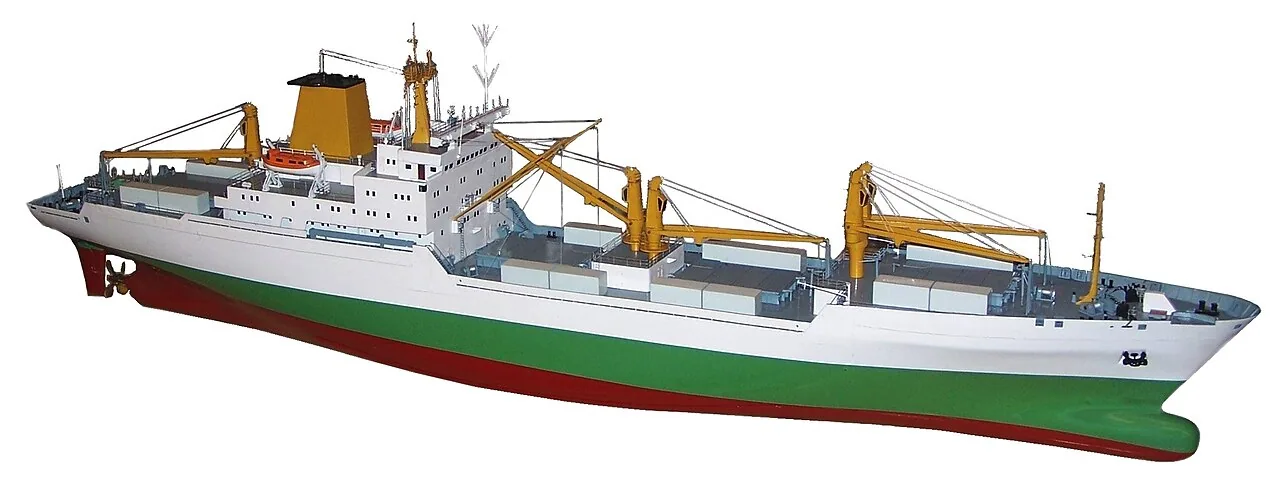
MV Kooringa holds the distinction of being the world's first fully cellular, purpose-built container ship. It was built by Associated Steamships, an Australian company formed by the 1964 merger of the Adelaide Steamship Company with McIlwraith, McEacharn and Co, and was commissioned in May 1964.
The cellular design — in which the hull is divided into vertical cells defined by guide rails, each sized to accept a standard container — became the template for all subsequent large container ships. It eliminated the individual hatches, holds and dividers that characterised traditional cargo vessels and allowed containers to be stacked and secured efficiently.
How is a container ship's hull designed?
The hull of a modern container ship is built around a strong central keel, from which steel frames extend at right angles like ribs. The main deck is supported by beams running the full breadth of the ship, attached to the tops of these frames. The result is a structure of steel plates and strengthening beams capable of bearing the concentrated loads imposed by stacked containers.
Below deck, the hull is divided into one or more cargo holds, along with tanks and an engine room. The holds are closed by hatch covers, and additional containers are stacked on top of those covers above deck. The interior of a typical container ship's hold is often compared to a large warehouse, subdivided into individual cells by vertical guide rails that locate each container precisely and prevent shifting at sea.
Many container ships are fitted with cargo cranes, and most carry specialized systems for securing containers on board. Containers themselves are most commonly built of steel, though aluminum, fiberglass and plywood are also used, and they are designed for direct transfer to rail cars, trucks or semi-trailers without intermediate handling.
How large are today's container ships?
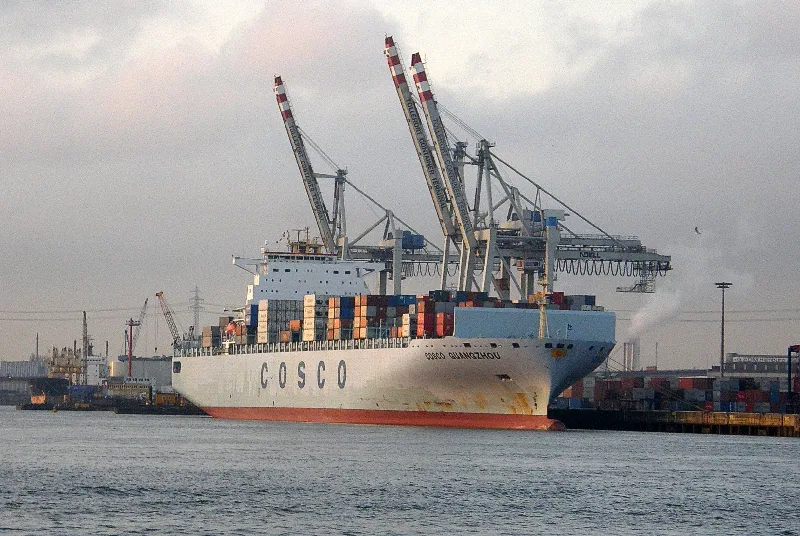
The largest container ships built from 2023 onward measure approximately 400 metres (1,300 ft) in length and can carry more than 24,000 TEU. To put that carrying capacity in context, one such ship equals the cargo-carrying ability of sixteen to seventeen pre-Second World War freighters.
The global container ship fleet stands at around 50,000 vessels of varying sizes. Typical cargoes are a mix of standard 20-foot and 40-foot ISO containers, with the 40-foot (2-TEU) units predominating in most trades.
Frequently asked questions
What does TEU mean on a container ship?
TEU stands for twenty-foot equivalent unit, the standard measure of container ship capacity. One 20-foot ISO container equals 1 TEU, while the more commonly used 40-foot container equals 2 TEU. The largest container ships, from 2023 onward, can carry over 24,000 TEU.
What percentage of world cargo travels by container ship?
About 90% of all non-bulk cargo worldwide is transported by container ships. By 2001 that figure already applied to non-bulk trade goods moving in ISO containers, and by 2009 nearly one quarter of all dry cargo globally — roughly 125 million TEU or 1.19 billion tonnes — was moving by container.
Who invented the modern container ship?
Malcom McLean is most closely associated with making container shipping commercially viable. He adapted surplus T2 tankers to carry uniform metal containers and on 26 April 1956 the Ideal X completed the first such voyage, from Port Newark to Houston with 58 containers. The first purpose-built cellular container ship, however, was Australia's MV Kooringa, commissioned in May 1964.
What was the world's first container ship?
The SS Autocarrier, owned by the Southern Railway in Britain, is recorded as the world's first container ship; it was launched in February 1931 and carried 21 containers for the railway's London–Paris passenger train service. The much older Starvationer, designed by James Brindley in 1766, used wooden containers on an English canal but predates the concept of a seagoing container ship.
How much has containerization reduced shipping costs?
Containerization has reduced shipping costs by 35% and cut shipping time by 84% compared with the previous practice of loading and unloading break-bulk cargo piece by piece. The efficiency gain comes from moving up to 64,000 lb (29,000 kg) of cargo as a single unit, secured to the ship in one standardized operation.
What is a fully cellular container ship?
A fully cellular container ship is one whose entire cargo space is organized as a grid of vertical cells, each bounded by guide rails sized to accept a standard container. MV Kooringa, commissioned in May 1964 by Australian company Associated Steamships, was the first vessel built to this specification. The cellular arrangement replaced the individual hatches, holds and dividers of earlier cargo ships and is now the standard design for large container vessels.
What materials are shipping containers made from?
Shipping containers are most commonly constructed of steel, which provides strength and weather resistance. Aluminum, fiberglass and plywood are also used in certain applications. All standard containers are designed for intermodal transfer — they can move directly between container ships, rail cars, trucks and semi-trailers without unpacking the cargo inside.
Sources
- Wikipedia: Container ship — Factual basis of this entry