Suez Canal
The Suez Canal is an artificial, sea-level waterway crossing the Isthmus of Suez in Egypt, linking the Mediterranean Sea to the Red Sea. Opened on 17 November 1869, the canal stretches 193.3 kilometres (120.1 miles) from Port Said in the north to Port Tewfik at the city of Suez in the south, physically dividing Africa from Asia and the Sinai Peninsula from the Egyptian mainland.
By connecting the North Atlantic and northern Indian oceans via the Mediterranean and the Red Sea, the canal eliminates the need to circumnavigate Africa via the South Atlantic and southern Indian oceans. That shortcut reduces the voyage from the Arabian Sea to London by approximately 8,900 km (5,500 mi), cutting transit time to roughly ten days at 20 knots or eight days at 24 knots.
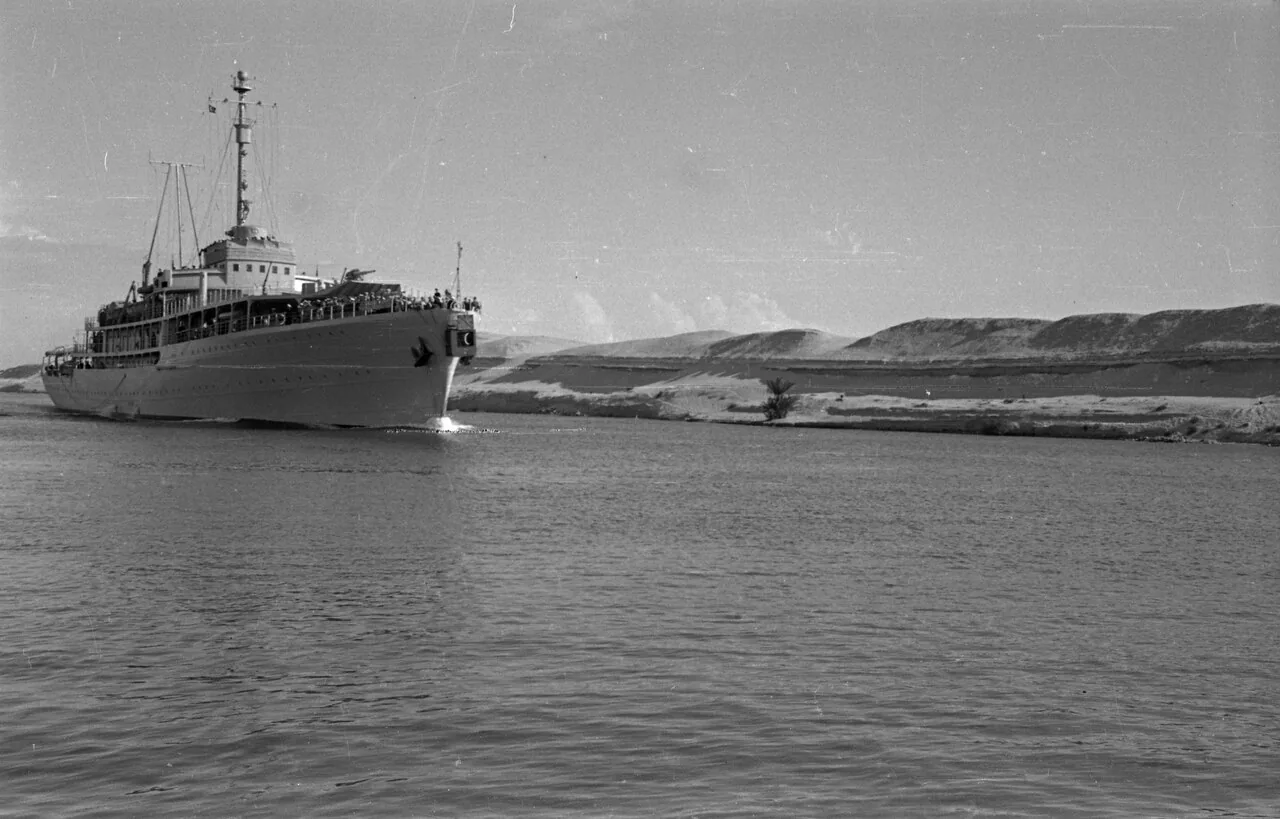
| Type | Artificial sea-level waterway, no locks |
| Total length | 193.3 km (120.1 mi) |
| Northern terminus | Port Said, Egypt |
| Southern terminus | Port Tewfik, Suez, Egypt |
| Opened | 17 November 1869 |
| Designed by | Alois Negrelli |
| Operator | Suez Canal Authority (Egyptian state-owned) |
| Annual transits (2021) | More than 20,600 vessels (average 56 per day) |
| 2016 expansion scope | Ballah Bypass widened 35 km; daily capacity raised from 49 to 97 ships |
| Distance saved, Arabian Sea to London | Approx. 8,900 km (5,500 mi) |
What route does the Suez Canal provide?
The canal offers a direct navigable corridor between the North Atlantic Ocean and the northern Indian Ocean, threading through the Mediterranean Sea and then the Red Sea. Without it, vessels travelling between Europe and Asia would need to round the Cape of Good Hope, adding thousands of kilometres via the South Atlantic and southern Indian oceans.
The northern approach leads from the Mediterranean into Port Said, while the southern approach connects Port Tewfik at Suez to the Red Sea and onward to the Arabian Sea, the Indian Ocean, and beyond. The canal thus sits at the junction of two major intercontinental trade corridors.
Physical characteristics of the waterway
Unlike the Panama Canal, the Suez Canal operates without locks because the Mediterranean Sea and the Red Sea are at approximately the same elevation, allowing seawater to flow freely along its full length. The canal was designed on this lock-free principle by Alois Negrelli.
Current behaviour within the canal varies by location and season. North of the Bitter Lakes, water flows northward in winter and southward in summer. South of the Bitter Lakes, the current responds to tidal patterns at Suez rather than to seasonal cycles.
When was the canal built, and who built it?
In 1858, French diplomat Ferdinand de Lesseps founded the Compagnie de Suez specifically to finance and construct the waterway. Construction commenced the following year, 1859, and the canal was inaugurated on 17 November 1869 after a decade of work.
At opening, the canal operated as a single-lane waterway. Vessels requiring two-way passage used designated passing locations at the Ballah Bypass and in the Great Bitter Lake, an arrangement that established the fundamental operational pattern maintained, in updated form, for more than 150 years.
Ownership and administration
From its opening, the canal was legally Egyptian government property, but the Compagnie de Suez, whose shareholders were predominantly British and French, held the concession to operate it. That arrangement persisted until 1956, when President Gamal Abdel Nasser nationalised the canal, triggering the month-long Suez Crisis.
Following nationalisation, control passed to Egypt's state-owned Suez Canal Authority, which operates and maintains the canal today. Under the Convention of Constantinople, the canal is open in both peacetime and wartime to vessels of commerce and war of any flag without distinction.
Strategic importance as a shipping chokepoint
Because the canal provides the only navigable sea-level passage between the Mediterranean and the Red Sea, it functions as a critical chokepoint for global freight and naval movements. It is of particular significance to nations with coastlines or naval installations on either of the two connecting seas.
In 2021, more than 20,600 vessels transited the canal, averaging 56 per day, illustrating the volume of trade that depends on this single corridor. Any closure has immediate consequences for shipping routes and cargo delivery times across Europe, Asia, and East Africa.
Closures and their effect on routes
Egypt closed the Suez Canal at the outset of the Six-Day War in 1967, and it remained out of service until 1975 — a closure of approximately eight years. During that period, vessels were forced back onto the Cape of Good Hope route, adding thousands of kilometres and many days to voyages between Europe and Asia.
The closure demonstrated how heavily global trade had come to depend on the canal and reinforced its status as an indispensable element of the international maritime network.
2016 expansion and capacity increase
A major expansion programme completed in 2016 widened the Ballah Bypass section by 35 km (22 mi), reducing overall transit time and nearly doubling theoretical daily vessel capacity from 49 to 97 ships. The works also created a new terminal at the canal's northern end.
The project, valued at LE 59.4 billion (approximately US$9 billion), was financed entirely through interest-bearing investment certificates sold exclusively to Egyptian individuals and entities, without recourse to foreign capital.
Ancient precursor canals
Long before the modern canal existed, ancient engineers attempted to link the Nile River system with the Red Sea via west-to-east canals across the Isthmus. One channel is associated with either Senusret II or Ramesses II; a later canal was begun under Necho II (reigning 610–595 BCE) through the Wadi Tumilat between Bubastis and Heroopolis, though Necho reportedly never completed it.
The first fully functional canal connecting the Nile to the Red Sea was engineered under the Persian king Darius I, who ruled from 522 to 486 BCE. Napoleon Bonaparte's engineers rediscovered remnants of this ancient west-east route through the Egyptian cities of Bubastis, Pi-Ramesses, and Pithom during their survey of 1799. A northward extension of the Darius I canal, running from Lake Timsah to the Ballah Lakes, was identified in the twentieth century and dated to Egypt's Middle Kingdom period.
Frequently asked questions
How much distance does the Suez Canal save on a voyage from the Arabian Sea to London?
The canal shortens the journey from the Arabian Sea to London by approximately 8,900 km (5,500 mi). At a speed of 20 knots that equates to around ten days of sailing time saved; at 24 knots, the saving is roughly eight days. Without the canal, vessels would need to sail around the southern tip of Africa.
Does the Suez Canal have locks?
No. The canal was designed by Alois Negrelli as a sea-level waterway with no locks, because the Mediterranean Sea and the Red Sea sit at essentially the same elevation. Seawater flows freely through the entire 193.3-kilometre channel without any need for the lifting chambers used in canals such as the Panama Canal.
Who operates the Suez Canal today?
The canal is operated and maintained by the Suez Canal Authority, an Egyptian state-owned body. Egypt nationalised the canal in 1956 under President Gamal Abdel Nasser, ending the concession held by the Compagnie de Suez, which had been controlled predominantly by British and French shareholders since the canal's construction.
How many ships use the Suez Canal each year?
In 2021, more than 20,600 vessels transited the canal, which works out to an average of 56 ships per day. The 2016 expansion was designed to bring theoretical daily capacity to 97 vessels, nearly double the pre-expansion figure of 49 ships per day.
When was the Suez Canal closed, and for how long?
Egypt closed the canal at the start of the Six-Day War in 1967, and it did not reopen until 1975, a closure lasting approximately eight years. During that period, all vessels travelling between Europe and Asia were diverted to the much longer route around the Cape of Good Hope.
What was the 2016 Suez Canal expansion?
The 2016 expansion project widened the Ballah Bypass section by 35 km (22 mi), reduced overall transit time, and established a new terminal at the canal's northern end. The LE 59.4 billion (around US$9 billion) programme was financed exclusively through investment certificates sold to Egyptian entities and individuals.
Were there earlier canals connecting the Nile to the Red Sea before the modern Suez Canal?
Yes. Ancient west-east canals were constructed at various points in Egyptian history to link the Nile with the Red Sea. The first fully functional version was completed under the Persian king Darius I (522–486 BCE), and remnants of that ancient route were rediscovered by Napoleon's engineers in 1799. Earlier attempts are attributed to rulers including Necho II and possibly Senusret II or Ramesses II.
Sources
- Wikipedia: Suez Canal — Factual basis of this entry