Port of Singapore
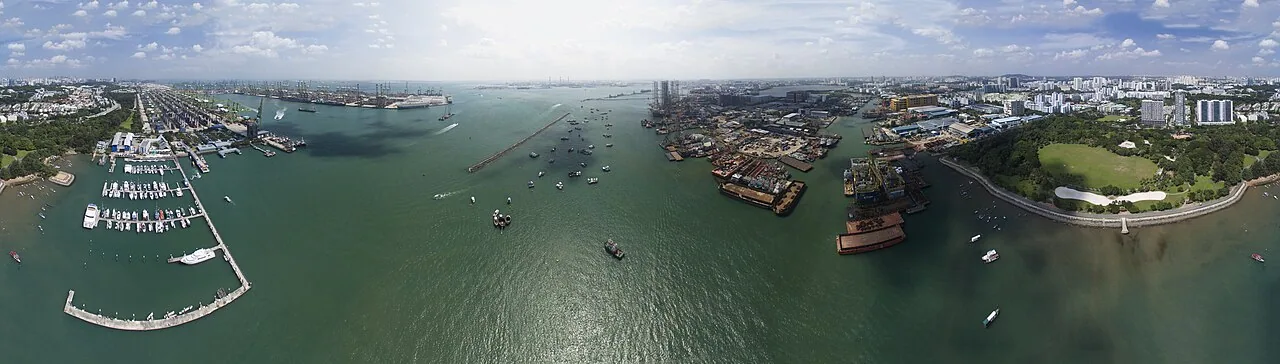
The Port of Singapore is a network of terminals and harbour facilities through which Singapore conducts its maritime trade. Owing to the city-state's position at the junction of the Indian Ocean and the Pacific Ocean, it has functioned as a major international entrepôt and trading post for at least two centuries, and since 2015 has been ranked the world's top maritime capital.
The port currently ranks as the world's second-busiest by total shipping tonnage, handles roughly one-fifth of the world's container transshipments, and moves approximately half of the world's annual crude oil supplies. It is simultaneously ranked the world's busiest transshipment port and the world's largest bunkering port.
| Status | World's top maritime capital (ranked since 2015) |
| Global rank by shipping tonnage | Second-busiest in the world |
| Container transshipment share | Approximately one-fifth of global container transshipments |
| Crude oil supply share | Approximately half of world's annual crude oil supplies |
| Bunkering | World's largest bunkering port |
| Rank by cargo tonnage handled | World's busiest until 2010, surpassed by Port of Shanghai |
| Key waterway | Singapore Strait, through which the majority of ships between Indian Ocean and Pacific Ocean pass |
| Northern strait | Straits of Johor — impassable for ships due to the Johor-Singapore Causeway, built 1923 |
| Causeway link | Connects Woodlands, Singapore, to Johor Bahru, Malaysia |
| Settlement founding | Modern port established 1819 by Stamford Raffles at Keppel Harbour |
Role and Strategic Importance
Singapore's geographic position on the Singapore Strait places it on the principal shipping route between the Indian Ocean and the Pacific Ocean, with the majority of vessels transiting between those two oceans passing through the strait. The Straits of Johor to the north are blocked to shipping by the Johor-Singapore Causeway, a fixed link built in 1923 connecting Woodlands, Singapore, to Johor Bahru in Malaysia, which concentrates maritime traffic through the southern approach.
Because Singapore has neither significant land area nor natural resources, its ports carry a weight for the national economy that extends beyond trade facilitation. The port is central to a model in which raw materials are imported, domestically processed — through activities such as oil refining and wafer fabrication — and then re-exported as higher-value products, generating value-added revenue that the country could not otherwise obtain.
The port's bunkering function reinforces this centrality: as the world's largest bunkering port, Singapore supplies fuel to vessels calling from across the global shipping network, adding a further layer of economic activity to the harbour's operations.
Pre-Colonial Origins: Before 1819
In the late thirteenth century, a kingdom known as Singapura was established on the north bank of the Singapore River at a location called the Old Harbour. This made it the only port in the southern part of the Strait of Malacca, and it competed for regional trade with ports along the Malacca Strait including Jambi, Kota Cina, Lambri, Semudra, Palembang, South Kedah, and Tamiang.
The port served two distinct economic functions at that time. First, it supplied goods demanded by international markets: the Chinese trader Wang Dayuan, born in 1311 and active between approximately 1328 and 1339, recorded in his 1349 work Daoyi Zhilüe (Brief Annals of Foreign Islands) that Singapore offered top-quality hornbill casques, lakawood, and cotton, goods distinguished from similar items at other Southeast Asian ports by their quality. Second, it acted as a gateway linking its immediate hinterland — South Johor and the Riau Archipelago — into the wider regional and international trading system, with cotton transshipped through Singapore from Java and India.
Archaeological evidence corroborates these written accounts. From 1984, excavations at Fort Canning Hill led by archaeologist Dr John Miksic uncovered earthenware, ceramic, and porcelain pieces demonstrating Singapore's active role as an international trading port in the fourteenth century. Ceramics and glassware recovered from the Riau Archipelago further confirm that Singapore functioned as the primary source of foreign imports for its surrounding region.
By the fifteenth century Singapore had receded as an international port following the rise of the Malacca Sultanate, though local trade continued. A map drawn by Portuguese mathematician Manuel Godinho de Eredia recorded the location of Xabandaria, the office of a shahbandar — the Malay official responsible for overseeing international trade. Finds of fifteenth-century Siamese ceramics and late sixteenth- or early seventeenth-century Chinese blue-and-white porcelain at the Singapore and Kallang Rivers indicate continued, if reduced, commercial activity. Singapore also continued to supply regional ports with locally sourced products: blackwood, the European term for rosewood, was exported to Malacca and subsequently purchased by Chinese traders for shipment to China for furniture-making. In the early seventeenth century, the main settlement and port were destroyed by a punitive expedition from Aceh, ending significant port activity until 1819.

How Was the Modern Port Established?
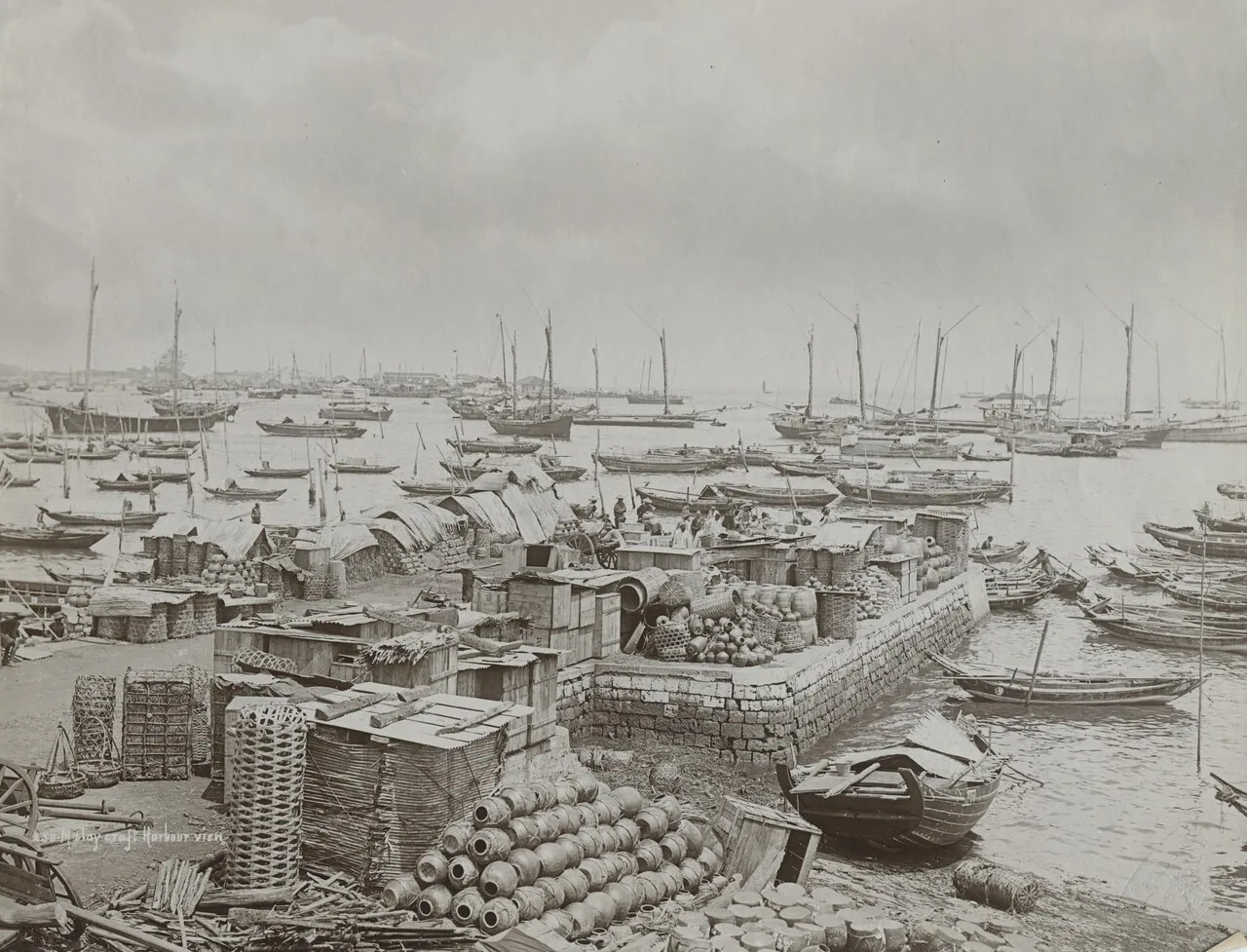
In 1819, British colonial official Stamford Raffles chose the site of Keppel Harbour for a new settlement and trading port on behalf of the British Empire, attracted by its deep and sheltered waters. To stimulate commerce, Raffles directed that land along the banks of the Singapore River — particularly the south bank — be reclaimed where needed and allocated to Chinese and English country traders so that they would develop a commercial stake in the settlement.
The two trading communities organised themselves along the river according to their trading patterns. Chinese traders, whose commercial interactions with Southeast Asian partners continued throughout the year, established their trading houses along the lower reaches of the river. English country traders, whose business depended on the annual seasonal arrival of trade from India, set up warehouses along the upper reaches.
The new port was built on three complementary trade networks already operating in the region: the Chinese network connecting Southeast Asia with the southern Chinese ports of Fujian and Guangdong; the Southeast Asian network linking the islands of the Indonesian archipelago; and the European and Indian Ocean network connecting Singapore to the markets of Europe and the Indian Ocean littoral. These networks reinforced one another and established Singapore as the transshipment centre for both regional and international trade. By the 1830s Singapore had overtaken Batavia — present-day Jakarta — as the centre of the Chinese junk trade and had become the leading hub of English country trade in Southeast Asia.
Container Transshipment and Cargo Throughput
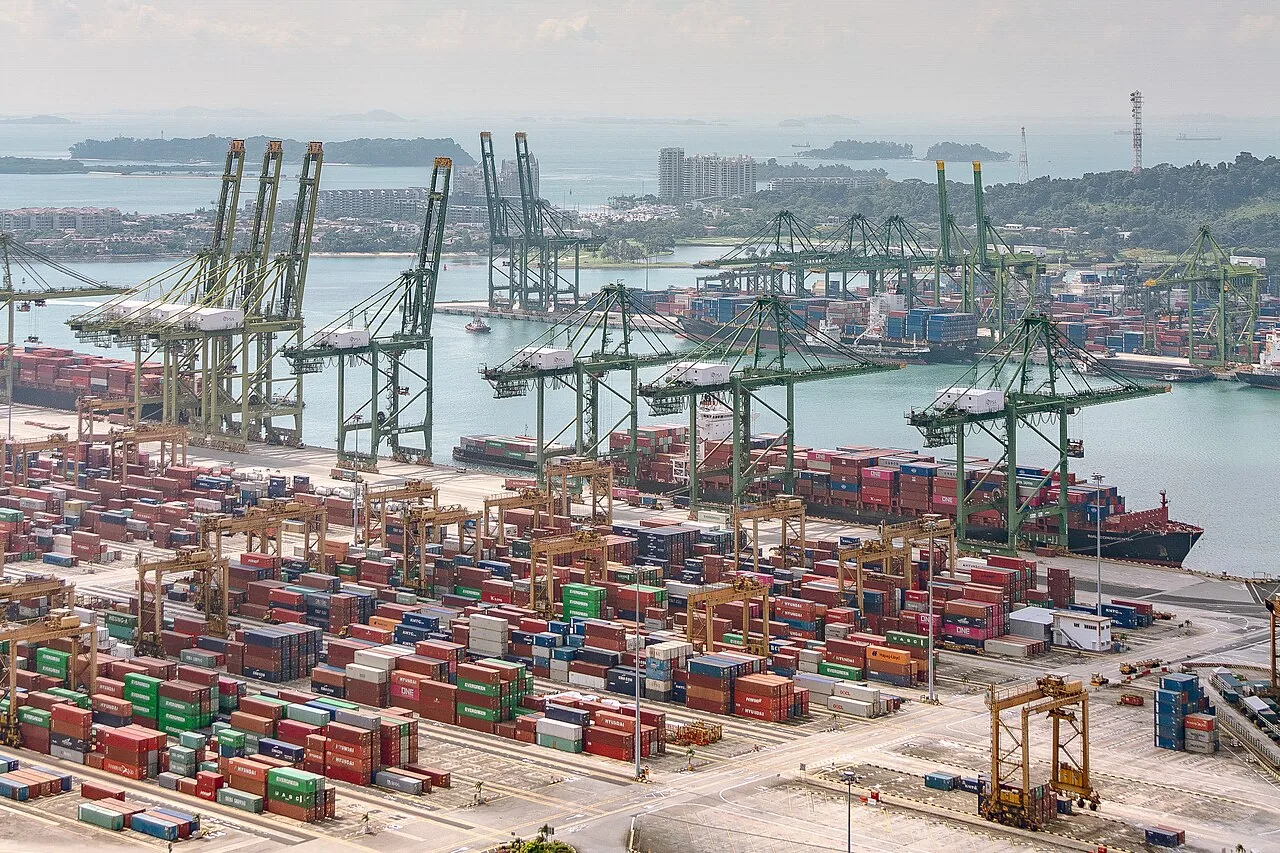
The Port of Singapore currently transships approximately one-fifth of the world's shipping containers, a share that underpins its ranking as the world's busiest transshipment port. This role reflects the port's function as a hub at which cargo from multiple origins is consolidated and redistributed onto onward services, rather than simply serving the import and export needs of Singapore's own domestic economy.
In terms of total cargo tonnage handled, the port held the rank of the world's busiest for an extended period until 2010, when it was surpassed by the Port of Shanghai. It continues to rank second globally by total shipping tonnage, illustrating the sustained scale of its operations even after ceding the top position by that specific measure.
Oil and Bunkering
The Port of Singapore handles approximately half of the world's annual crude oil supplies, reflecting the city-state's established position in petroleum transshipment and refining. Oil refining is one of the value-added processing activities that the port model supports: crude oil is imported, refined domestically, and the refined products are then re-exported at higher value.
The port's status as the world's largest bunkering port is a direct consequence of the volume of vessel traffic passing through the Singapore Strait. Ships transiting between the Indian Ocean and the Pacific Ocean represent a substantial and regular demand for marine fuel, and Singapore's position on that route makes it the natural point at which that demand is concentrated and met.
Maritime Capital Ranking
Since 2015, Singapore has been ranked the world's top maritime capital, a designation that encompasses the breadth of maritime services and infrastructure concentrated in the city-state, not only the physical throughput of its port facilities. This ranking sits alongside the port's individual records in transshipment, bunkering, and crude oil handling to form a composite picture of Singapore's centrality to global maritime commerce.
The city-state's maritime significance rests on a combination of factors: its location on one of the world's most heavily trafficked sea lanes, its lack of domestic resources which orients the economy toward trade and processing, and the accumulation of complementary port-related services built up over the more than two centuries since Raffles established the modern settlement in 1819.
Frequently asked questions
Why is Singapore considered the world's most important transshipment port?
Singapore handles approximately one-fifth of the world's shipping containers as a transshipment hub, meaning cargo arriving from multiple origins is consolidated and re-dispatched on onward routes rather than simply serving Singapore's own trade. Its position on the Singapore Strait, the principal corridor between the Indian Ocean and the Pacific Ocean, places it on the natural routing of a vast proportion of global container traffic. This combination of geographic position and accumulated port infrastructure has sustained its ranking as the world's busiest transshipment port.
When did the Port of Singapore lose its rank as the world's busiest port by cargo tonnage?
The Port of Singapore held the rank of world's busiest port measured by total cargo tonnage handled until 2010, when it was surpassed by the Port of Shanghai. It continues to rank second globally by total shipping tonnage, so the scale of its operations remains among the largest in the world despite the change at the top of that particular ranking.
What is bunkering, and why is Singapore the world's largest bunkering port?
Bunkering refers to the supply of fuel to ships. Singapore ranks as the world's largest bunkering port because the Singapore Strait carries the majority of vessels transiting between the Indian Ocean and the Pacific Ocean, generating a continuous and large-scale demand for marine fuel at that location. The port's geographic position makes it the logical and most efficient point at which that demand is served.
How did Singapore's port function in the fourteenth century?
In the late thirteenth and fourteenth centuries, the port of Singapura on the north bank of the Singapore River served as the sole port in the southern Strait of Malacca. It supplied internationally demanded goods — documented by Chinese trader Wang Dayuan in 1349 as including hornbill casques, lakawood, and cotton — and acted as a gateway through which South Johor and the Riau Archipelago accessed international markets. Archaeological excavations at Fort Canning Hill from 1984 onwards, led by Dr John Miksic, confirmed the port's active international trading role through finds of earthenware, ceramics, and porcelain.
Why does the Johor-Singapore Causeway matter for port routing?
The Johor-Singapore Causeway, built in 1923, links Woodlands in Singapore to Johor Bahru in Malaysia and physically blocks the Straits of Johor to ship traffic. Because the northern strait is impassable for vessels, all maritime traffic between the Indian Ocean and the Pacific Ocean is directed through the Singapore Strait to the south, concentrating shipping on the route that passes Singapore's port facilities.
How was the modern port at Singapore founded, and by whom?
Stamford Raffles, a British colonial official, established a new settlement and international trading port at Keppel Harbour in 1819, drawn by its deep and sheltered waters. He directed that land along the Singapore River's south bank be reclaimed and allocated to Chinese and English country traders to give them a commercial interest in the settlement's growth. The port subsequently organised itself around three pre-existing regional trade networks — Chinese, Southeast Asian, and European and Indian Ocean — which together positioned Singapore as the transshipment centre for both regional and international trade.
What role does oil refining play in the port's economic model?
Because Singapore lacks land and natural resources, the port's economic value depends significantly on importing raw materials, processing them domestically, and re-exporting the resulting higher-value products. Oil refining is a principal example of this model: crude oil — roughly half of the world's annual supply passes through — is imported, refined, and the refined products re-exported at added value. Wafer fabrication is cited alongside oil refining as another activity in this value-added processing model.
Since when has Singapore been ranked the world's top maritime capital?
Singapore has held the ranking of world's top maritime capital since 2015. This designation reflects the concentration of maritime services, infrastructure, and commercial activity in the city-state beyond the raw throughput figures of the port itself, encompassing its leading positions in transshipment, bunkering, and crude oil handling.
Sources
- Wikipedia: Port of Singapore — Factual basis of this entry