Port of Los Angeles
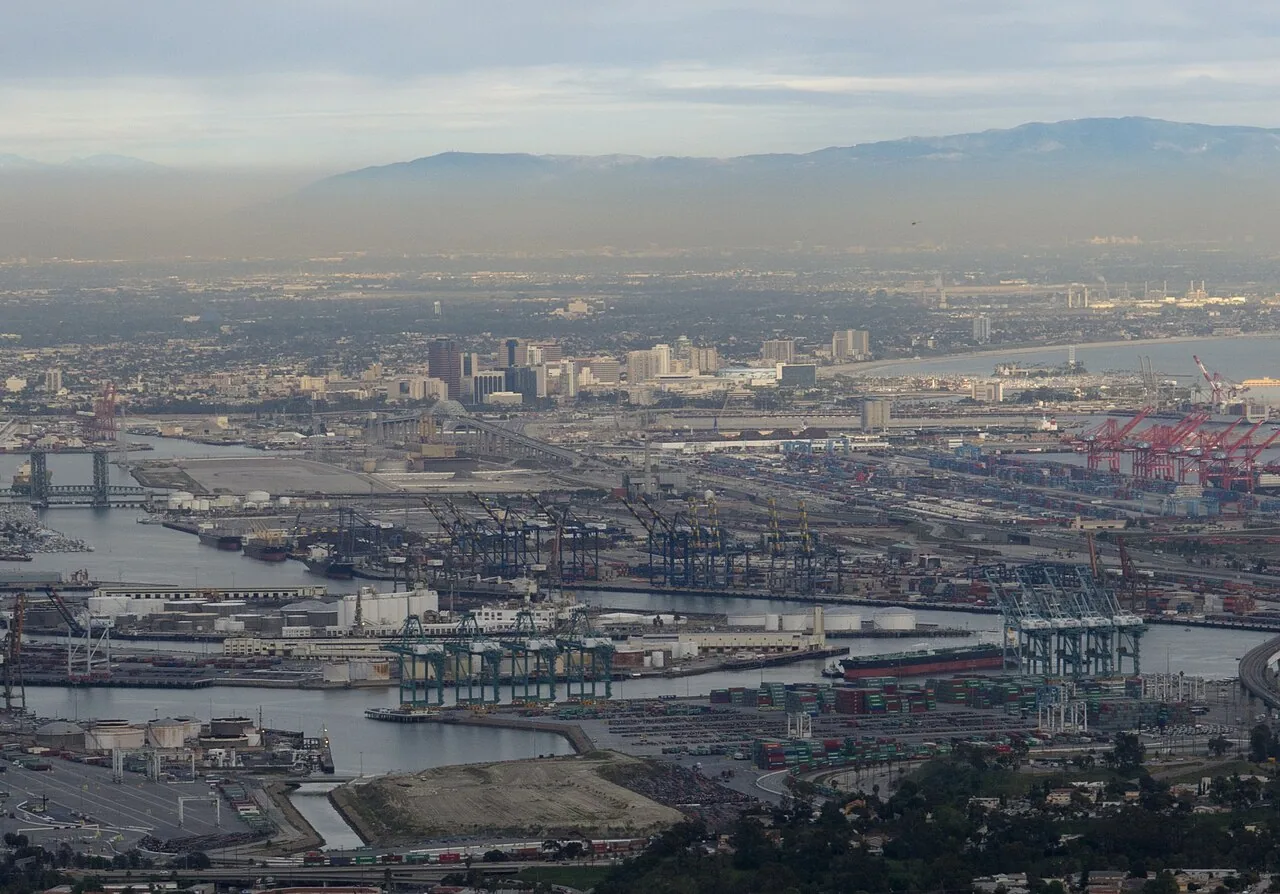
The Port of Los Angeles is a seaport situated in San Pedro Bay within the San Pedro and Wilmington neighborhoods of Los Angeles, approximately 20 miles south of downtown. Administered by the Los Angeles Harbor Department, a department of the City of Los Angeles, it covers 7,500 acres of land and water and shares a boundary with the separate Port of Long Beach.
The port operates eight container terminals equipped with 82 container cranes, served by 113 miles of on-dock rail, across a total of 25 cargo terminals along 43 miles of waterfront.
| Type | Public seaport |
| Operator | Los Angeles Harbor Department, City of Los Angeles |
| Location | San Pedro Bay, San Pedro and Wilmington neighborhoods, Los Angeles |
| Total area | 7,500 acres (3,000 ha) land and water |
| Waterfront | 43 miles (69 km) |
| Container terminals | 8 |
| Container cranes | 82 |
| On-dock rail | 113 miles (182 km) |
| Governing body | Board of Harbor Commissioners (founded 1907) |
| First million-container year | 1985 |
Location and administration
The port occupies San Pedro Bay, roughly 20 miles south of downtown Los Angeles, within the San Pedro and Wilmington neighborhoods. It directly adjoins the Port of Long Beach, though the two facilities are separately administered.
Governance rests with the Los Angeles Harbor Department, an independent, self-supporting department of the City of Los Angeles, overseen by a five-member Board of Harbor Commissioners. The Board itself was established in 1907, predating several of the port's major expansions.
How did the Port of Los Angeles come to be built at San Pedro rather than Santa Monica?
The original bay was a shallow mudflat incapable of supporting a wharf, requiring visiting vessels either to anchor offshore and ferry goods to land or to beach themselves entirely. This difficult situation was described first-hand by Richard Henry Dana Jr., who visited San Pedro Bay as a crew member on an 1834 voyage and recorded the experience in Two Years Before the Mast.
Phineas Banning transformed the site in 1871 by dredging the channel to Wilmington to a depth of 10 feet, enabling the port to handle 50,000 tons of shipping that year. Banning also constructed a railroad connecting San Pedro Bay to Los Angeles in 1868, the first rail link in the area, and operated stagecoach routes reaching Salt Lake City and Yuma.
Following Banning's death in 1885, the port reached 500,000 tons of annual shipping under the stewardship of his sons. A rival scheme backed by the Southern Pacific Railroad and Collis P. Huntington sought to establish a major port at Santa Monica, where the Long Wharf was built in 1893. Los Angeles Times publisher Harrison Gray Otis and U.S. Senator Stephen White opposed this plan and campaigned for federal investment at San Pedro Bay instead.
The dispute, known as the Free Harbor Fight, was resolved in 1897 when a federal commission chaired by Rear Admiral John C. Walker endorsed San Pedro. Walker subsequently became chair of the Isthmian Canal Commission in 1904. U.S. government support followed, breakwater construction began in 1899, and the area was formally annexed to Los Angeles in 1909.
Early twentieth-century growth and the 1932 Olympics
The Southern Pacific Railroad completed its first major wharf at the port in 1912, marking the beginning of substantial rail-linked cargo handling. By the 1920s the port had surpassed San Francisco to become the busiest seaport on the West Coast.
In the early 1930s a large construction program extended a breakwater three miles out from shore, over two miles in length, while an inner breakwater was added off Terminal Island. The resulting enclosed harbor hosted the sailing events of the 1932 Summer Olympics.
Before mechanical refrigeration became widespread in the 1930s, fish canning was a central industry at the port. Companies including StarKist and the Van Camp Seafood Company operated along Tuna Street on Terminal Island, drawing immigrant fishermen from Croatia, Japan, and Portugal who worked alongside their families in the canneries.
Terminal Island and the displacement of Japanese-American residents
Japanese-Americans began settling at the port around 1906, recruited by the canneries for their skills in fishing and canning and offered subsidized housing as an incentive. By 1940 approximately 3,000 Japanese-Americans were living on Terminal Island.
Following the attack on Pearl Harbor, nativist pressure led the U.S. government to order the forced removal of Americans of Japanese ancestry from coastal areas. Terminal Islanders were sent to inland camps and permitted to take only what they could carry, frequently compelled to abandon or sell property at a fraction of its value.
The federal government also seized substantial portions of Terminal Island through eminent domain to accelerate shipbuilding for the war effort, effectively dismantling the fishing community that had developed there over several decades. A small memorial now marks what was once a thriving settlement.
World War II, containerization, and postwar expansion
During World War II the port shifted predominantly to shipbuilding, employing more than 90,000 workers at its peak. The transition toward modern cargo handling began in 1959, when Matson Navigation Company's vessel Hawaiian Merchant delivered 20 containers to the port, initiating containerized shipping operations.
The opening of the Vincent Thomas Bridge in 1963 significantly improved vehicular and cargo access to Terminal Island, enabling increased traffic volumes and further infrastructure expansion. The Pier 400 Dredging and Landfill Program, described as the largest such project in the United States, was completed in 2000.
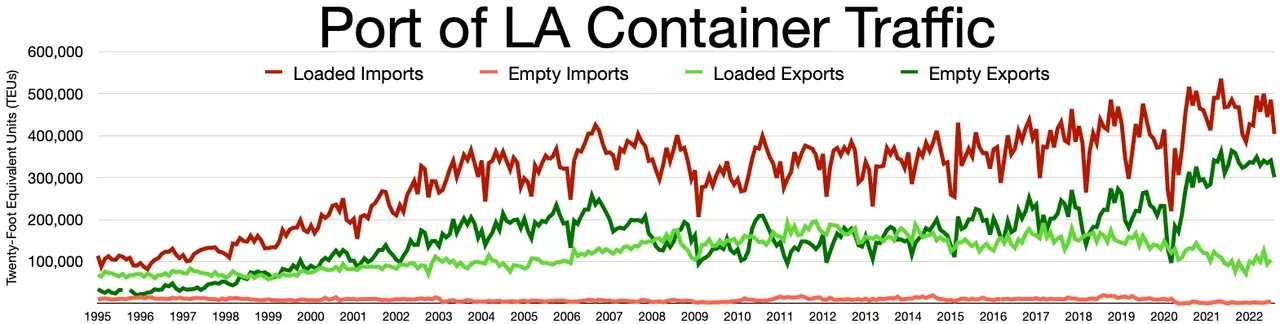
The port reached the milestone of handling one million containers in a single year for the first time in 1985. By 2013 container throughput had grown to more than half a million units moving through the port each month.
Infrastructure and cargo profile
The port operates 25 cargo terminals in total, of which eight are dedicated container terminals equipped with 82 container cranes. The 113 miles of on-dock rail connect terminal operations directly to the broader rail network.
Top imports have typically included furniture, automobile parts, apparel, footwear, and electronics. As of 2019, the leading export commodities were wastepaper, pet and animal feed, scrap metal, and soybeans. China including Hong Kong, Japan, and Vietnam were the port's three largest trading partners in 2020.
Efficiency, labor disputes, and congestion
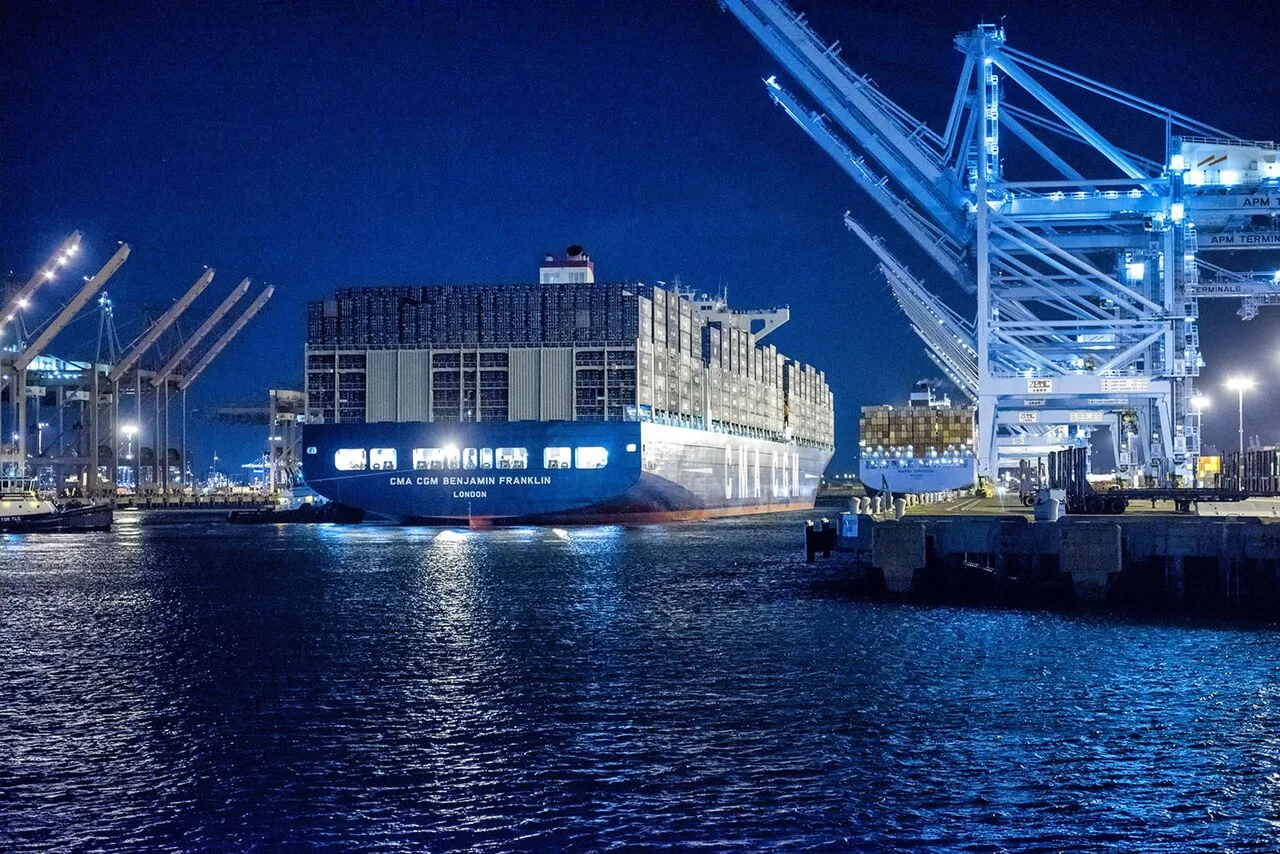
During the 2002 West Coast port labor lockout, the port accumulated a substantial backlog of vessels waiting offshore to be unloaded. Two decades later, disruptions arising from the COVID-19 pandemic produced a queue of 109 container ships blocking the port during 2021 and 2022, prompting a number of shipping operators to redirect cargo to alternative ports.
In 2022 the World Bank and IHS Markit ranked the Port of Los Angeles and the adjoining Port of Long Beach among the world's least efficient ports, attributing the assessment to union protectionism and an insufficient level of automation.
Frequently asked questions
Where exactly is the Port of Los Angeles located?
The port is situated in San Pedro Bay, within the San Pedro and Wilmington neighborhoods of Los Angeles, approximately 20 miles south of downtown Los Angeles. It shares a boundary with the separately administered Port of Long Beach.
Who manages the Port of Los Angeles?
The port is managed by the Los Angeles Harbor Department, an independent, self-supporting department of the City of Los Angeles. It is governed by a five-member Board of Harbor Commissioners, an institution that dates to 1907.
What are the port's main imports and exports?
The port's principal imports have typically been furniture, automobile parts, apparel, footwear, and electronics. As of 2019, the leading exports were wastepaper, pet and animal feed, scrap metal, and soybeans.
When did containerization begin at the Port of Los Angeles?
Containerization at the port began in 1959, when Matson Navigation Company's Hawaiian Merchant delivered 20 containers there. The port reached one million containers handled in a single year for the first time in 1985, and by 2013 more than half a million containers were moving through the port monthly.
Why were Japanese-Americans removed from Terminal Island?
Following the attack on Pearl Harbor, nativist organizations pressured the U.S. government to order the forced removal of Americans of Japanese ancestry from coastal areas. Around 3,000 Japanese-Americans had been living on Terminal Island since approximately 1906, recruited by fish canneries, but were sent to inland camps and permitted to bring only what they could carry, often losing property in the process. The federal government also seized much of the island's land through eminent domain for wartime shipbuilding.
How was the site at San Pedro chosen over Santa Monica for the port?
A federal commission chaired by Rear Admiral John C. Walker endorsed San Pedro Bay over the Southern Pacific Railroad's preferred location at Santa Monica in 1897, following a campaign by Los Angeles Times publisher Harrison Gray Otis and U.S. Senator Stephen White. The decision resolved what became known as the Free Harbor Fight, and U.S. government-backed breakwater construction began at San Pedro in 1899.
How did the COVID-19 pandemic affect the port?
Pandemic-related disruptions caused 109 container ships to queue outside the port during 2021 and 2022, creating severe congestion. The situation led a number of shipping operators to consider alternative ports, and in 2022 the World Bank and IHS Markit cited the Port of Los Angeles, together with the Port of Long Beach, as among the world's least efficient ports, referencing union protectionism and limited automation.
What role did Phineas Banning play in developing the port?
Phineas Banning was instrumental in making the port commercially viable by dredging the channel to Wilmington in 1871 to a depth of 10 feet, allowing the port to handle 50,000 tons of shipping that year. He had also built the first railroad connecting San Pedro Bay to Los Angeles in 1868 and operated stagecoach lines extending to Salt Lake City and Yuma.
Sources
- Wikipedia: Port of Los Angeles — Factual basis of this entry