Supply chain
A supply chain is a complex logistics system comprising facilities that convert raw materials into finished products and distribute those products to end consumers or end customers. Supply chain management focuses on optimising the flow of goods through distribution channels to achieve efficiency across the entire network.
The phrase 'supply chain' may have first appeared in print in a 1905 article in The Independent, which briefly noted the difficulty of keeping a supply chain with India unbroken during the British expedition to Tibet — an early recorded use of the concept in a geopolitical and logistics context.
| Type | Complex logistics system linking production, distribution and consumption |
| First recorded use of phrase | 1905, The Independent (British expedition to Tibet context) |
| Minimum entities required | At least three, per Mentzer et al. |
| Typical production stages | Component manufacture, then assembly plant |
| Typical distribution stages | Central and regional distribution centres to end consumers |
| Typical tiers in chemical industry supply chain | Nine, including product development and manufacture (Astrid Bosten, Henkel) |
| Ethics survey finding | 53% of supply chain professionals rated ethics 'extremely' important (Loyola University Chicago, 2018) |
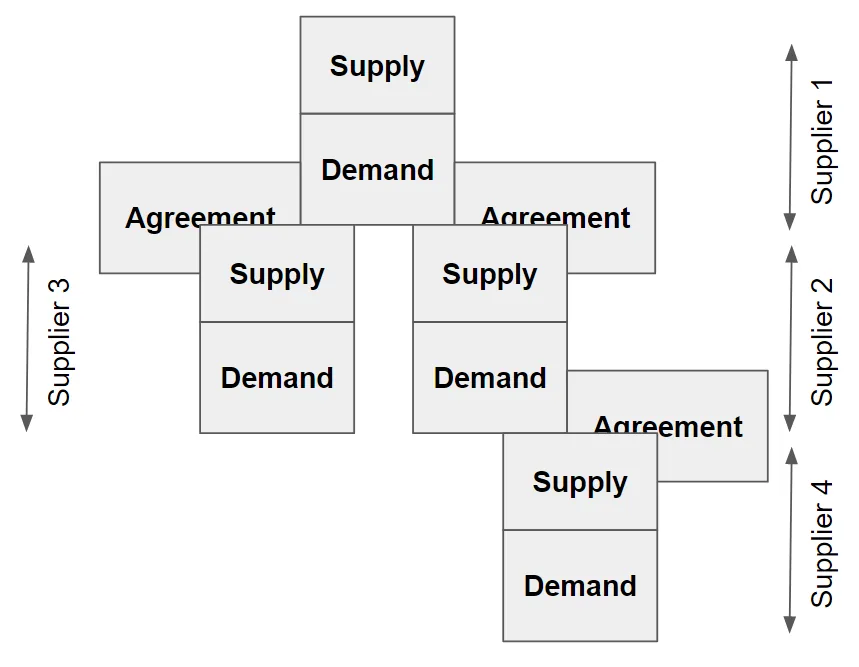
| Supplier tiers | First-tier (direct suppliers), second-tier (supply to first tier), and further hierarchical tiers |
| Key typology framework | Fisher (1997): functional/efficient vs. responsive/innovative supply chain strategies |
| Flow components identified by Fazel Zarandi et al. | Product or service, information, finances, and buyer-seller relations at each stage |
What is a supply chain?
A supply chain is a complex logistics system in which facilities convert raw materials into finished products and then deliver those products to end consumers or end customers. Supply chain management is the discipline concerned with optimising the flow of goods within the distribution channels of that system to maximise efficiency.
In sophisticated supply chain systems, used products may be reintroduced into the chain at any point where residual value remains recyclable. Supply chains are closely linked to value chains, and the two concepts are often considered together when analysing how value is created and transferred across a network of suppliers and buyers.
Structure: production and distribution stages
A typical supply chain divides into two broad stages: production and distribution. In the production stage, components and semi-finished parts are manufactured at production centres and subsequently assembled at an assembly plant.
The distribution stage encompasses central and regional distribution centres, which move finished products onward to end consumers. Academics Alan Harrison and Janet Godsell argue that supply chain processes should be coordinated around end customer buying behaviour, treating customer responsiveness as evidence that materials are able to flow through the full sequence of supply chain processes.
How are suppliers organised within a supply chain?
Suppliers within a supply chain are commonly arranged into tiers. First-tier suppliers, also called direct suppliers, provide goods or services directly to the client organisation. Second-tier suppliers supply the first tier, and this hierarchy extends further depending on the complexity of the product or industry.
Astrid Bosten of the German chemical and consumer goods company Henkel notes that a chemical industry supply chain typically contains nine tiers when product development and manufacture are both included. Operating across multiple tiers can generate additional costs through profit layering, whereby each tier's operators add a margin to their costs before passing them on. In 2015, the United Kingdom's Ministry of Justice identified this effect in its lift maintenance and refurbishment contracts, where a main contractor subcontracted the actual work to a specialist; the Ministry subsequently contracted directly with the specialist to avoid that layered cost.
Typologies: which supply chain fits which product?
Marshall L. Fisher posed the foundational question in a 1997 article: 'Which is the right supply chain for your product?' Fisher, together with Naylor, Naim and Berry writing in 1999, identified two matching pairs of supply chain characteristics: a combination of 'functional' and 'efficient', or a combination of 'responsive' and 'innovative', the latter pairing also used by Harrison and Godsell.
Mentzer et al. offer a parallel classification distinguishing between direct, extended and ultimate supply chains. A direct supply chain involves a company, one supplier and one customer. An extended supply chain adds the suppliers of the immediate supplier and the customers of the immediate customer, while an ultimate supply chain encompasses every organisation involved in supplying the product or service. Brown et al. further characterise supply chains as either loosely coupled or tightly coupled, with leading companies moving toward looser coupling in their operational processes.
Information, finance and buyer-seller relations
Beyond the physical movement of goods, the flow of information and finances forms an integral part of every supply chain in Mentzer et al.'s framework. Fazel Zarandi et al. add buyer-seller relations at each stage as a third core component alongside information flow, completing a picture of the chain as simultaneously a physical, financial and relational network.
Mentzer et al. also emphasise that a supply chain is defined by its end product or service: they cite 'the supply chain for candy' and 'the supply chain for clothing' as illustrative examples. A single actor may occupy different positions across multiple supply chains simultaneously; a bank, for instance, may play a supporting role in some chains while acting as the customer or the nearest supplier to the customer in the supply chain for security printing.
The extended enterprise and limits of the 'chain' metaphor
The linear image conveyed by the word 'chain' has attracted criticism as harder to relate to the way supply networks actually operate. A chain is in practice a complex and dynamic supply and demand network, and the loosely coupled, self-organising network of cooperating businesses has come to be called the extended enterprise.
Many exchanges within a supply chain take place between companies that each seek to maximise their own revenue and may have little knowledge of or interest in other participants elsewhere in the network. This fragmentation of interest and information is a structural feature of supply chains rather than an exception.
Ethics and transparency in supply chains
Many large companies and global brands incorporate codes of conduct and ethical guidelines into their corporate cultures and management systems. These guidelines commonly set requirements for suppliers, including manufacturing facilities, farms and subcontracted service providers such as cleaning, catering and security companies, and companies may use social audits to assess compliance.
Limited transparency across supply chains can make it difficult for consumers to identify the origins of products and may allow socially irresponsible practices to go undetected. A 2018 survey conducted by the Loyola University Chicago Supply and Value Chain Center found that 53 percent of supply chain professionals regarded ethics as extremely important to their organisations, indicating significant professional awareness of the issue even where full transparency remains elusive.
End-consumer demand as the driver of supply chain flows
At the downstream end of a supply chain, materials and finished products flow only because of customer behaviour. Harrison and Godsell's argument that supply chain processes should be coordinated to focus on end customer buying behaviour places consumer demand, rather than producer supply, at the analytical centre of the chain.
Mentzer et al. specify that at least three entities are required for a supply chain to exist, reinforcing the idea that a chain is inherently relational and not reducible to a single firm's internal logistics. The end state of the product or service is the reference point around which all upstream activities are ultimately organised.
Frequently asked questions
What is the difference between a supply chain and supply chain management?
A supply chain is the system itself — the network of facilities that convert raw materials into finished products and distribute them to end consumers. Supply chain management is the practice of optimising the flow of goods within that system's distribution channels to ensure efficiency. The two terms describe the structure and its governance respectively.
When was the phrase 'supply chain' first used?
The phrase may have first appeared in print in a 1905 article published in The Independent, which mentioned the difficulty of keeping a supply chain with India unbroken during the British expedition to Tibet. This is the earliest recorded use of the specific term in its logistical sense.
What are first-tier and second-tier suppliers?
First-tier suppliers, also called direct suppliers, provide goods or services directly to the client organisation. Second-tier suppliers supply to the first tier, and this hierarchical structure continues through further tiers depending on the complexity of the supply network. In the chemical industry, Henkel's Astrid Bosten notes there are typically nine such tiers.
What are the main typologies of supply chains identified in the literature?
Marshall L. Fisher (1997) and Naylor, Naim and Berry (1999) identified two strategic pairings: functional combined with efficient, or responsive combined with innovative. Mentzer et al. separately distinguish direct, extended and ultimate supply chains by the breadth of entities included. Brown et al. offer the distinction between loosely coupled and tightly coupled supply chains.
What is profit layering and why does it matter?
Profit layering occurs when each tier within a supply chain adds its own profit margin to costs before passing them down the chain, potentially raising overall costs for the end purchaser. The UK Ministry of Justice encountered this in 2015, when a main contractor was subcontracting lift work to a specialist at an additional margin. The Ministry resolved the issue by contracting directly with the specialist contractor.
How important is ethics to supply chain professionals?
A 2018 survey by the Loyola University Chicago Supply and Value Chain Center found that 53 percent of supply chain professionals considered ethics to be extremely important to their organisations. Limited supply chain transparency can allow socially irresponsible practices to go undetected, making ethical guidelines and social audits tools that companies use to manage supplier conduct.
What is the extended enterprise?
The extended enterprise refers to the loosely coupled, self-organising network of businesses that cooperate to provide product and service offerings, extending beyond the boundaries of any single firm. The term emerged partly in response to criticism that the word 'chain' implies a linear structure that does not accurately reflect how supply networks actually function, which are more accurately described as complex and dynamic.
What components make up a supply chain beyond the physical product?
Mentzer et al. identify the flow of information and the flow of finances as integral parts of a supply chain alongside the physical product or service. Fazel Zarandi et al. further add buyer-seller relations at each stage as a third main component, recognising that the network is also a structure of commercial and relational exchange at every link.
Sources
- Wikipedia: Supply chain — Factual basis of this entry